Home | Future Students | Degrees & Certificates | Industrial Machine Technology
Industrial Machine Technology
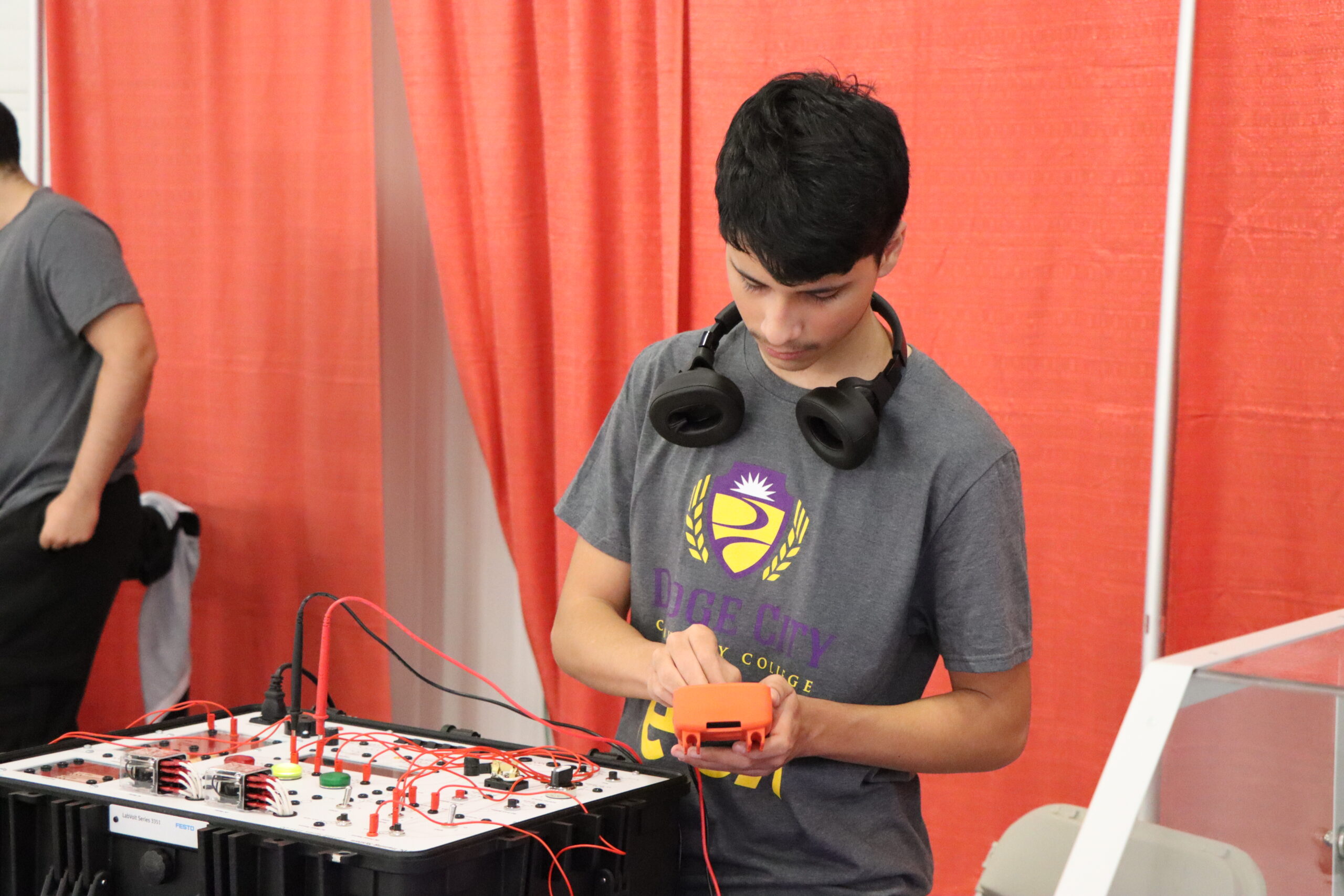
The Industrial Machine Technology program provides entry-level skills necessary to enter and excel in the industrial maintenance and advanced manufacturing industries. Industrial and automated manufacturing concepts are built upon through extensive hands-on training with modern equipment and systems. Students develop skills in mechanical systems, electricity, motor controls, programmable logic controllers (PLCs), fluid power, automation, and robotics while learning to troubleshoot, repair, and maintain industrial machinery. The manufacturing industry has a strong demand for qualified technicians who can keep complex equipment operating efficiently. Graduates may find employment in manufacturing plants, processing facilities, and industrial operations, with opportunities to advance into specialized technical, supervisory, or automation-focused roles as they gain experience.
Program Description
The DC3 Industrial Machine Technology program is aligned with the National Center for Education Statistics (NCES) CIP code 47.0303: Industrial Mechanics and Maintenance Technology. A program that prepares individuals to apply technical knowledge and skills to repair and maintain industrial machinery and equipment such as cranes, pumps, engines and motors, pneumatic tools, conveyor systems, production machinery, marine deck machinery, and steam propulsion, refinery, and pipeline-distribution systems.
Program graduates will have earned OSHA 10 certification and will be prepared to take the Certified Maintenance and Reliability Technician (CMRT) exam administered by the Society for Maintenance & Reliability Professionals (SMRP).
Program Information
About Program (Skills)
Students completing the Industrial Machine Technology program will gain the following:
- Electrical & Electronics: Reading schematics, troubleshooting circuits, and understanding AC/DC drives and motors.
- Mechanics, Hydraulics & Pneumatics: Knowledge of gears, bearings, pumps, and fluid power systems.
- Fluid Power: Designing, maintaining, and troubleshooting industrial machinery that utilizes pressurized liquids (hydraulics) or compressed gases (pneumatics) to transmit force and motion.
- Programmable Logic Controllers (PLCs): Writing and interpreting ladder logic, monitoring I/O modules, and troubleshooting.
- Robotics & Automation: Basic programming, teaching pendants, and understanding kinematic configurations for robotic assembly and material handling.
Career Options
Graduates of the Welding Technology program may pursue the following careers:
- Industrial Machinery Mechanics & Maintenance Technicians
- Repair, install, and adjust factory equipment, conveyor systems, and refinery pipelines.
- Require a deep understanding of electrical, hydraulic, pneumatic, and mechanical schematics.
- Heavily focused on diagnostic troubleshooting, routine preventative maintenance, and safety compliance.
- CNC Machinists & Programmers
- Set up, operate, and script data for Computer Numerical Control (CNC) lathes, mills, and routers.
- Read complex blueprints to shape metals, plastics, and alloys within incredibly precise tolerances.
- Advanced roles focus on CAD/CAM software integration and G-code editing.
- Industrial Machine Operators
- Handle day-to-day operations of specific production machinery, such as brake presses or injection molders.
- Use high-accuracy measuring tools like micrometers, calipers, and bore gauges for quality control.
- Often act as the first line of defense in detecting product defects and machine malfunctions.
- Automation & Robotics Technicians
- Program and maintain advanced robotic arms (such as FANUC systems) used for high-speed material handling.
- Focus on optimizing machine cycles and building specialized fixtures.
- Bridge the gap between mechanical hardware and advanced industrial software.

2 years (61 credits)
Associate of Applied Science

1.5 year (49 credits)
Certificate
Tuition
$30*/per credit hour
Fees
$125**/per credit hour
Books
All materials are included
Other Program Fees
$59***
* This rate applies to residents of Ford County. The rate for residents outside of Ford County is $60/per credit hour. International rate is $80/per credit hour.
** Online Courses have an additional $10/per credit hour fee.
*** There are additional course fees for certain lab courses.
Tuition and fees are subject to change

Fall
Students may start this program at the beginning of the fall semester.

Job Outlook*
Industrial Machinery Mechanics & Maintenance Technicians – 13% Growth

Annual Median Salary*
Industrial Machinery Mechanics & Maintenance Technicians – $63,510
*As of August 2025
Faculty
Sample Degree Plan
Year 1
Fall I: (16 Credits)
- IND 106 1001 – AC/DC Circuits – 4 Credit
- IND 120-1001 – Bench Work – 1 Credits
- IND 125-1001 – Mechanical Systems – 3 Credits
- IND 160-1001 – Electrical Control Systems I – 3 Credits
- OSHA 110-1306 – OSHA 10 – 1 Credits
- IND 170-1001 – Quality Control and Inspection – 1 Credits
- MATH 100-1001 – Applications of Technical Analysis – 3 Credits
Spring I: (15 Credits)
- MT 133-1001 – Shielded Metal Arc Welding (SMAW)- 3 Credits
- IND 145-1001 – Mechanical Systems Reliability – 3 Credits
- ELEC 150-1001 – Variable Frequency Drives – 3 Credits
- IND 235-1001 – Industrial Process Control – 3 Credits
- MT 254-1001 – Gas Tungsten Arc Welding (GTAW) – 3 Credits
Year 2
Summer I: (15 Credits)
- IND 200-1001 – Fluid Power I – 3 Credits
- IND 201-1001 – Fluid Power II – 3 Credits
- IND 215-1001 – Programable Logic Controllers (PLC) – 3 Credits
- IND 250-1001 – Robotics I – 3 Credits
- IND 260-1001 – Electrical Control Systems II – 3 Credits
Fall II: (15 Credits)
- *^ENG 102 or *ENG 104 – English Comp I T▶ – 3 Credits
- *SP 206 – Interpersonal Communication T▶ – 3 Credits
- CS 101 – Computer Concepts & Apps T▶ – 3 Credits
- BUS 100, ECON 101 or ECON 102 – Intro to Business, Macro, or Micro Econ T▶ – 3 Credits
- 3 PE or HLTH 101 – 3 PE Electives or First Aid T▶ – 3 Credits
Year 1
Fall I: (16 Credits)
- IND 106 1001 – AC/DC Circuits – 4 Credit
- IND 120-1001 – Bench Work – 1 Credits
- IND 125-1001 – Mechanical Systems – 3 Credits
- IND 160-1001 – Electrical Control Systems I – 3 Credits
- OSHA 110-1306 – OSHA 10 – 1 Credits
- IND 170-1001 – Quality Control and Inspection – 1 Credits
- MATH 100-1001 – Applications of Technical Analysis – 3 Credits
Spring I: (15 Credits)
- MT 133-1001 – Shielded Metal Arc Welding (SMAW)- 3 Credits
- IND 145-1001 – Mechanical Systems Reliability – 3 Credits
- ELEC 150-1001 – Variable Frequency Drives – 3 Credits
- IND 235-1001 – Industrial Process Control – 3 Credits
- MT 254-1001 – Gas Tungsten Arc Welding (GTAW) – 3 Credits
Year 2
Summer I: (15 Credits)
- IND 200-1001 – Fluid Power I – 3 Credits
- IND 201-1001 – Fluid Power II – 3 Credits
- IND 215-1001 – Programable Logic Controllers (PLC) – 3 Credits
- IND 250-1001 – Robotics I – 3 Credits
- IND 260-1001 – Electrical Control Systems II – 3 Credits
- *SP 206 – Interpersonal Communication T▶ – 3 Credits
Key
T▶ Kansas Systemwide Transfer Course
* Course requires a C or higher
^ Course has a testing or prerequisite requirement
Click here to see all of our available Degree Maps.